
What is the New Silk Road?
The New Silk Road is a commonly used name for the Belt and Road Initiative (BRI), launched by China in 2013. The original concept included the overland Silk Road Economic Belt and a maritime route connecting China with other regions of the world, but over time it was expanded to include further areas of cooperation. PISM (the Polish Institute of International Affairs) pointed out in its early analyses that the initiative is not a single infrastructure undertaking, but a broad, long-term concept encompassing trade, investment, transport and project financing.
Where does the idea of the modern Silk Road come from?
The name of the modern initiative refers to the historical network of trade routes connecting China with Central Asia, Persia, India and Europe. The historical Silk Road was not a single road either - it consisted of numerous branches that ran, among other places, through Kashgar, Samarkand, Bukhara and parts of the Middle East towards the Mediterranean Sea. This analogy helps explain the modern BRI concept: today, too, it is primarily about a network of different connections between East and West, rather than a single designated corridor.
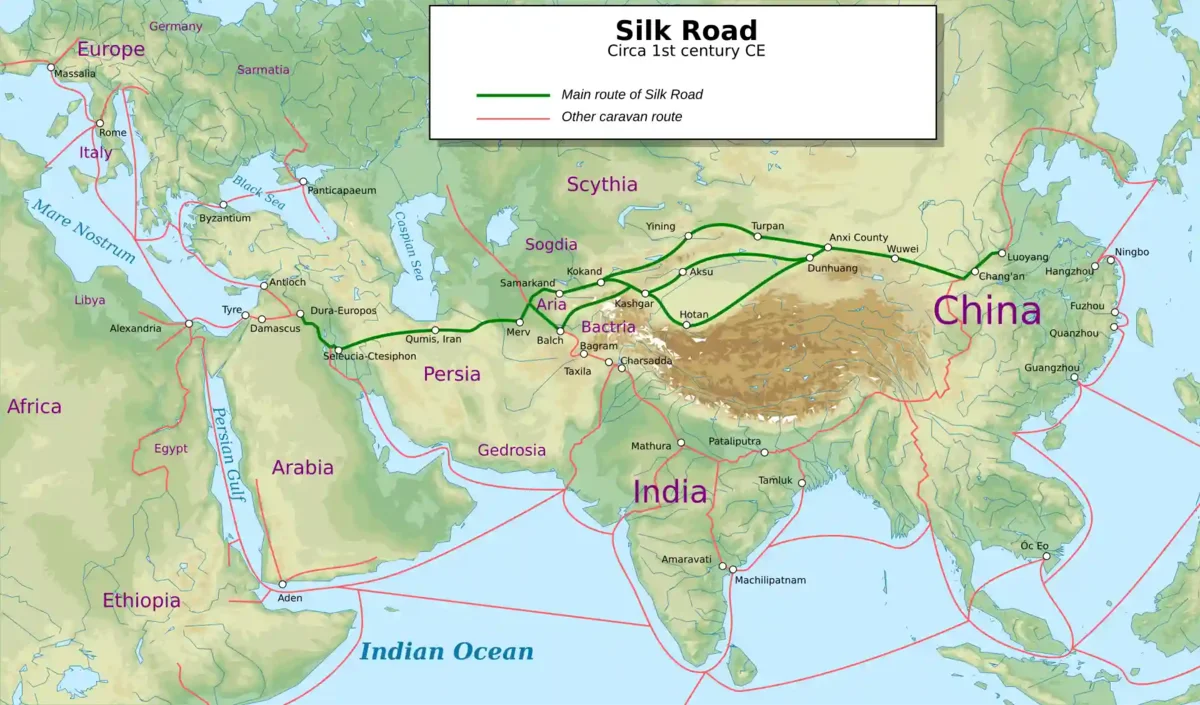
What route does the New Silk Road follow?
The modern New Silk Road comprises several parallel corridors connecting China with Asia, Europe and other regions of the world. China's white paper on BRI identifies six major economic corridors, including the New Eurasian Land Bridge, the China-Mongolia-Russia corridor and the China-Central Asia-West Asia corridor.
Overland corridors through Central Asia
Central Asia is one of the most important areas for the overland connections being developed between China and the West. Kazakhstan, Kyrgyzstan and Uzbekistan participate in infrastructure projects intended to increase freight transport capacity across the region, and PISM described Central Asia as crucial to the overland branch of the Belt and Road Initiative. In 2026, the China-Kyrgyzstan-Uzbekistan railway line is also being developed, which the Chinese authorities classify as one of the important BRI projects in the region. The expansion of further routes increases the number of available transit options between China, Central Asia and more distant markets.
The New Silk Road railway between China and Europe
The railway dimension of the New Silk Road consists of a network of freight connections between Chinese logistics centres and European cities. According to China's white paper, by mid-2023 the China-Europe Railway Express already reached more than 200 cities in 25 European countries, and the total number of completed journeys exceeded 74 thousand. These figures come from a government source of the People's Republic of China and present the official Chinese assessment of BRI's development, so they should be interpreted as figures from the Chinese side.
What role does Poland play on the railway route?
Poland lies on the European section of the freight railway connections linking China with the EU market. As early as its 2015 analysis, PISM identified direct railway connections with China as one of the elements enabling Poland to participate in the initiative and develop trade. Poland's importance therefore stems primarily from its location on the east-west axis and its ability to handle the onward flow of goods into the European market, although specific routes and the importance of individual crossings may change as alternative corridors develop.
What does the maritime New Silk Road look like?
The maritime New Silk Road develops connections between Chinese ports and Southeast Asia, the Indian Ocean, the Middle East, Africa and Europe. According to the figures presented by the Chinese side in the BRI white paper, the Maritime Silk Road network included 117 ports in 43 countries by the end of June 2023. Maritime transport therefore remains a parallel component of the initiative alongside railway and overland connections, and for businesses the choice between them depends, among other things, on the type of goods, delivery time, costs and the availability of infrastructure.
What is the Digital Silk Road?
The Digital Silk Road is the technological component of the BRI initiative, developed by China since 2015. According to PISM, it includes, among other things, telecommunications infrastructure, 5G networks, fibre-optic cables, cloud services, big data analysis and e-commerce solutions, and its importance goes beyond traditional logistics. The development of this part of the initiative is also associated with technological competition, data security and the promotion of Chinese technological standards in foreign markets.
Why is Central Asia becoming increasingly important for trade between China and Europe?
Central Asia's importance stems from its location between China, Europe, Russia, the Middle East and the Caspian Sea region. The development of railway connections and transport infrastructure increases the possibilities for transit through Kazakhstan, Kyrgyzstan or Uzbekistan, and the China-Kyrgyzstan-Uzbekistan railway project shows that this direction continues to expand. In September 2026, during Chinese-Kyrgyz talks, the continued implementation of this line was once again identified as one of the important cooperation projects under BRI.
What does the New Silk Road mean for Polish businesses?
The New Silk Road gives companies trading with Asia access to different models for organising carriage and several potential transit directions. Access to infrastructure alone does not, however, determine the profitability of a particular transaction - a business should assess transport costs, formalities, trade terms, the counterparty and the risks present in individual markets. Amberlan supports the organisation of trade in goods between Europe and the countries of Central Asia and Eastern Europe, including counterparty verification and logistical support as part of trade and the development of cooperation in eastern markets.
What should be checked before choosing a specific route?
The choice of corridor should be based on the parameters of the particular transaction, rather than simply on a route's popularity. Transit countries, the number of transshipments, required documents, customs clearance, the type of goods transported and insurance and delivery terms must be taken into account. The cheapest or shortest route does not always mean the lowest operational risk, especially when the supply chain spans several different legal systems and customs borders.
Summary
The New Silk Road combines railways, maritime transport, infrastructure projects and digital solutions, so it cannot be reduced to a single route from China to Europe. For trading companies, the greatest value lies in the ability to use different transport directions, but the decision should always take account of costs, formal requirements and the situation in transit markets.
If you are planning trade, the development of cooperation or a business project in Central Asia and Eastern Europe, contact Amberlan and verify the possibilities for operating before making a decision: https://www.amberlan.com/en/
Bibliography and sources
[1] Polish Institute of International Affairs, Justyna Szczudlik, Silk Road: what is China's new priority strategy, 02.07.2015, https://www.pism.pl/publikacje/Jedwabny_Szlak___czym_jest_nowa_priorytetowa_chi_ska_strategia [accessed 21.09.2026].
[2] Polish Institute of International Affairs, Justyna Szczudlik, Three years of the Silk Road: successes and challenges, 02.11.2016, https://www.pism.pl/publikacje/Trzy_lata_Jedwabnego_Szlaku__sukcesy_i_wyzwania [accessed 21.09.2026].
[3] Polish Institute of International Affairs, Damian Wnukowski, Polar Silk Road: the Arctic in Chinese foreign and economic policy, 23.11.2018, https://www.pism.pl/publikacje/Polarny_Jedwabny_Szlak__Arktyka_w_chi_skiej_polityce_zagranicznej_i_gospodarczej [accessed 21.09.2026].
[4] Polish Institute of International Affairs, Damian Wnukowski, China's Digital Silk Road - economic and political significance, 17.11.2020, https://www.pism.pl/publikacje/Chinski_Cyfrowy_Jedwabny_Szlak___znaczenie_gospodarcze_i_polityczne [accessed 21.09.2026].
[5] Polish Institute of International Affairs, Episode 311: “The RCEP agreement and the Digital Silk Road: China increases its economic and political influence”, 19.11.2020, https://www.pism.pl/pism_w_mediach/podcasty/odcinek-311-umowa-rcep-oraz-cyfrowy-jedwabny-szlak-chiny-zwiekszaja-wplywy-gospodarcze-i-polityczne [accessed 21.09.2026].
[6] The State Council of the People's Republic of China, Key takeaways from BRI white paper, 11.10.2023, https://english.www.gov.cn/news/202310/11/content_WS6526994fc6d0868f4e8e024a.html [accessed 21.09.2026].
[7] The State Council of the People's Republic of China, Xi's Kyrgyzstan visit promotes permanent good-neighborliness, friendship: Chinese FM, 03.09.2026, https://english.www.gov.cn/news/202609/03/content_WS6a996992c6d00ca5f9a0cfcf.html [accessed 21.09.2026].
[8] The State Council of the People's Republic of China, Xi's Central Asia, Middle East tour injects certainty, positive energy into world in flux, 10.09.2026, https://english.www.gov.cn/news/202609/10/content_WS6aa20ce5c6d00ca5f9a0d1ac.html [accessed 21.09.2026].
[9] Wikipedia, Silk Road - source of the map used as historical context, https://pl.wikipedia.org/wiki/Jedwabny_Szlak [accessed 21.09.2026].