
What is Incoterms 2020?
Incoterms 2020, or International Commercial Terms, is a set of international trade rules developed by the International Chamber of Commerce - ICC. Their purpose is to standardise how the seller's and buyer's obligations related to the delivery of goods are defined, so that parties from different countries do not have to agree on every element of transport from scratch. One correctly specified rule can define a significant part of the allocation of delivery costs and risk. The current edition, Incoterms 2020, came into force on 1 January 2020.
What do the Incoterms 2020 rules define?
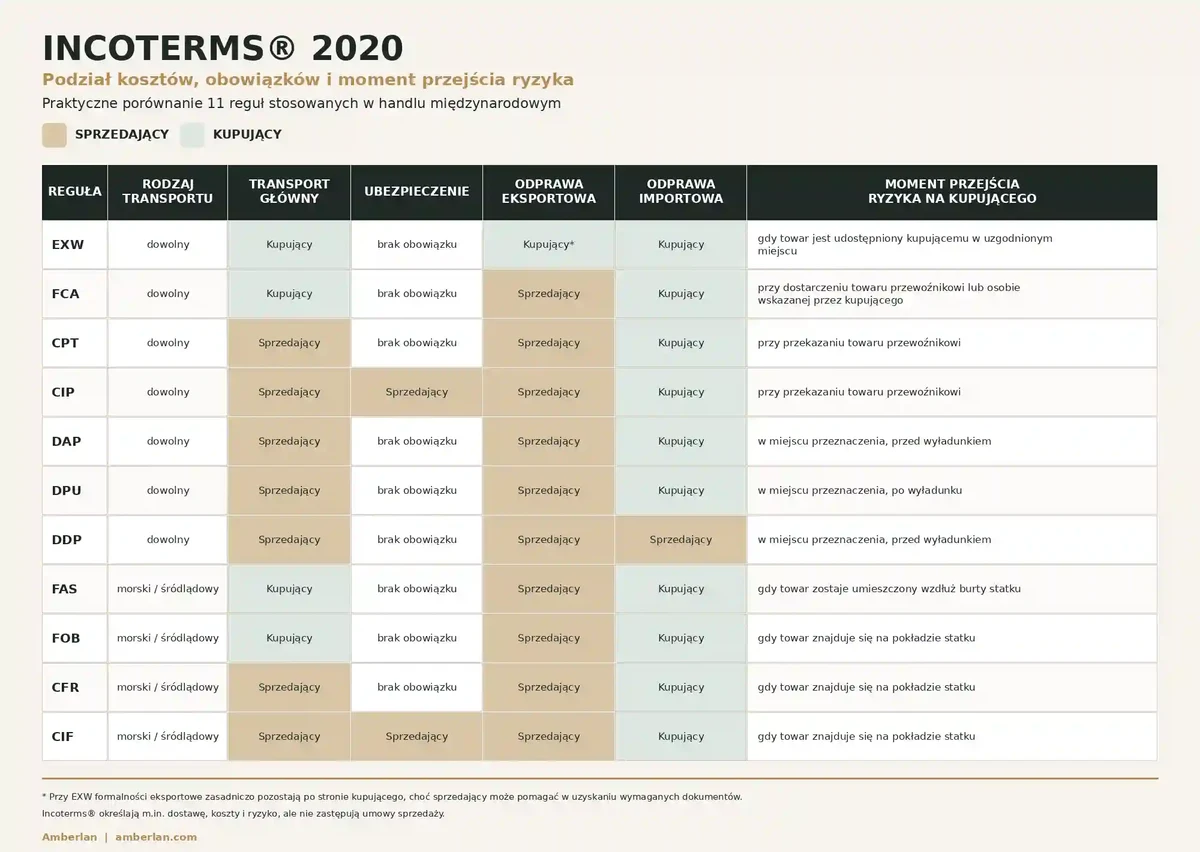
The Incoterms 2020 rules primarily define who is responsible for the individual stages of delivery and at what point the risk of loss of or damage to the goods passes from the seller to the buyer. They also regulate the allocation of specific costs of transport, loading, unloading and insurance, as well as obligations related to export and import clearance. The cost of carriage and the point at which risk transfers do not always coincide, which is particularly important under CPT, CIP, CFR and CIF. Therefore, simply determining which party pays for transport is not sufficient to define the scope of responsibility for the goods.
Are Incoterms 2020 international trade regulations?
Incoterms 2020 are international trade rules used in sales contracts, but they do not constitute a standalone legal code governing the entire transaction. They do not replace a sales contract and do not define all matters related to payment, transfer of ownership of the goods or the law applicable to a potential dispute. Their scope focuses primarily on delivery, costs, risk and the parties' transport obligations. Therefore, in international trade, the principles of Incoterms 2020 should be applied alongside a properly prepared contract and the regulations in force in the countries involved in the transaction.
How are the Incoterms 2020 rules divided?
Incoterms 2020 includes 11 rules classified by the possible mode of transport. Seven of them - EXW, FCA, CPT, CIP, DAP, DPU and DDP - can be used regardless of the selected mode or combination of modes of transport. The remaining four - FAS, FOB, CFR and CIF - are intended for sea and inland waterway transport. The choice of rule should therefore begin by determining the mode of carriage and the point at which the parties wish to transfer risk.
| Rule | Meaning | Mode of transport |
|---|---|---|
| EXW | Ex Works - from the factory | All modes of transport |
| FCA | Free Carrier - delivered to the carrier | All modes of transport |
| CPT | Carriage Paid To - carriage paid to | All modes of transport |
| CIP | Carriage and Insurance Paid To - carriage and insurance paid to | All modes of transport |
| DAP | Delivered at Place - delivered to the place | All modes of transport |
| DPU | Delivered at Place Unloaded - delivered to the place, unloaded | All modes of transport |
| DDP | Delivered Duty Paid - delivered, duty paid | All modes of transport |
| FAS | Free Alongside Ship - delivered alongside the ship | Sea and inland waterway transport |
| FOB | Free On Board - delivered on board the ship | Sea and inland waterway transport |
| CFR | Cost and Freight - cost and freight | Sea and inland waterway transport |
| CIF | Cost, Insurance and Freight - cost, insurance and freight | Sea and inland waterway transport |
How does EXW work?
Under EXW, the seller makes the goods available to the buyer at an agreed place, which may be, for example, a production plant or a warehouse. The seller is not obliged to load the goods onto the collecting vehicle or carry out export clearance if it is required. Most transport-related obligations are therefore assumed by the buyer, who arranges onward carriage and bears the associated risk. The parties should specify the exact collection point for the goods as precisely as possible.
What does FCA involve?
Under FCA, the way the goods are handed over depends on the place specified by the parties in the contract. If delivery takes place at the seller's premises, it occurs after the goods have been loaded onto the means of transport arranged by the buyer; at another place, the goods must be delivered there by the seller and placed at the carrier's disposal. FCA precisely defines the point at which the goods are handed over to the carrier and risk transfers. Incoterms 2020 also extended the rules concerning the seller's ability to obtain a transport document confirming loading.
How do CPT and CIP differ?
Under CPT, the seller concludes and pays for a contract of carriage to the specified destination, but risk passes to the buyer when the goods are handed over to the carrier. CIP works on a similar basis, but additionally requires the seller to arrange appropriate insurance for the goods. This means that the seller's payment for transport does not automatically mean that the seller bears the risk throughout the entire route. This distinction must be taken into account when calculating costs and securing the transaction.
How do DAP, DPU and DDP differ?
Under DAP, the seller bears the risk up to the specified destination, but the goods remain ready for unloading by the buyer. DPU is the only Incoterms 2020 rule under which the seller is also responsible for unloading at the destination, while under DDP the seller's obligations also include import clearance. DDP imposes the greatest range of obligations on the seller among the 11 Incoterms 2020 rules, so before using it, the ability to complete import formalities in the recipient's country must be checked. Under DAP and DPU, import-related obligations remain with the buyer.
How do FAS, FOB, CFR and CIF work in sea transport?
FAS, FOB, CFR and CIF are intended for sea and inland waterway transport and differ in the scope of the seller's obligations. Under FAS, risk transfers once the goods have been placed alongside the ship, whereas under FOB, CFR and CIF - when the goods are on board the ship. Under CFR, the seller pays the freight to the destination port, and under CIF additionally concludes an insurance contract. The point at which risk transfers may therefore come before the place up to which the seller pays for transport.
What changes were introduced in Incoterms 2020?
One of the most visible changes compared with the 2010 edition was the replacement of DAT with DPU - Delivered at Place Unloaded. The name change was intended to remove the suggestion that delivery must take place exclusively at a terminal, as the handover location may also be another agreed point. The FCA rules concerning a transport document confirming the loading of goods were also changed where its issuance had been appropriately agreed by the parties. The changes were primarily intended to clarify the practical application of the rules in international trade in goods.
How to choose the right Incoterms 2020 rule?
The choice of an Incoterms 2020 rule should take into account the mode of transport, the place where the goods are handed over, the degree of control over carriage, customs clearance and the expected allocation of costs and risk. The exporter should also check whether it can fulfil the obligations arising from the selected term in the destination country, particularly when considering DDP or arranging insurance. An unsuitable rule may transfer costs or risk to the company that were not taken into account when setting the contract price. When organising imports and exports in eastern markets, it is worth exploring Amberlan's support in international trade.
Why must the place of delivery be specified precisely in Incoterms?
Simply including the abbreviation EXW, FCA, DAP or DDP does not always allow the point at which the parties fulfil their obligations to be determined unambiguously. A specific place, port or delivery point must be indicated alongside the rule, as it may determine when risk transfers and how some costs are allocated. The more precisely the delivery point is defined, the less room there is for different interpretations of the counterparties' obligations. An example provision should therefore combine the chosen rule with a specific place and a reference to the Incoterms 2020 edition.
Incoterms 2020 in trade with eastern markets
Incoterms 2020 provides a common language for defining delivery terms, but does not eliminate legal, customs and organisational differences between individual countries. When trading with Central Asia and Eastern Europe, a business must also check local import procedures, clearance options, documentation and the actual course of transport. The Incoterms rule should reflect what both parties are operationally able to carry out in the particular market, rather than being selected solely on the basis of a previously adopted pattern.
How to reduce the risk of errors when using Incoterms?
The most common problems arise from choosing a rule without specifying the place of delivery precisely, confusing transport costs with the point at which risk transfers or failing to account for customs obligations. Before signing a contract, it is therefore worth agreeing separately on the organisation of carriage, insurance, loading and unloading, and export and import clearance, and then selecting the appropriate term to match these arrangements. Incoterms should reflect the actual delivery model rather than replace earlier commercial agreements. This helps reduce disputes over responsibility for the goods and unexpected costs after the transaction has been concluded.
Summary
The Incoterms 2020 rules make it possible to define clearly which party is responsible for transport, costs, formalities and risk at the individual stages of delivery. The most important considerations are choosing a rule that matches how the transaction is actually carried out and specifying the place of delivery precisely, rather than automatically applying one term to all contracts. Companies engaged in international trade should additionally verify the operational and formal requirements applicable in their counterparty's market.
If you are planning imports, exports or the development of trade channels in Central Asia and Eastern Europe, contact Amberlan: https://www.amberlan.com/en/
Bibliography and sources
[1] Biznes.gov.pl, Incoterms - international terms of sale, published on 23.09.2021, https://www.biznes.gov.pl/pl/portal/00622 [accessed 21.09.2026].
[2] International Chamber of Commerce, Incoterms® 2020, https://iccwbo.org/business-solutions/incoterms-rules/incoterms-2020/ [accessed 21.09.2026].