
What does the current mineral fertiliser market look like and what determines prices?
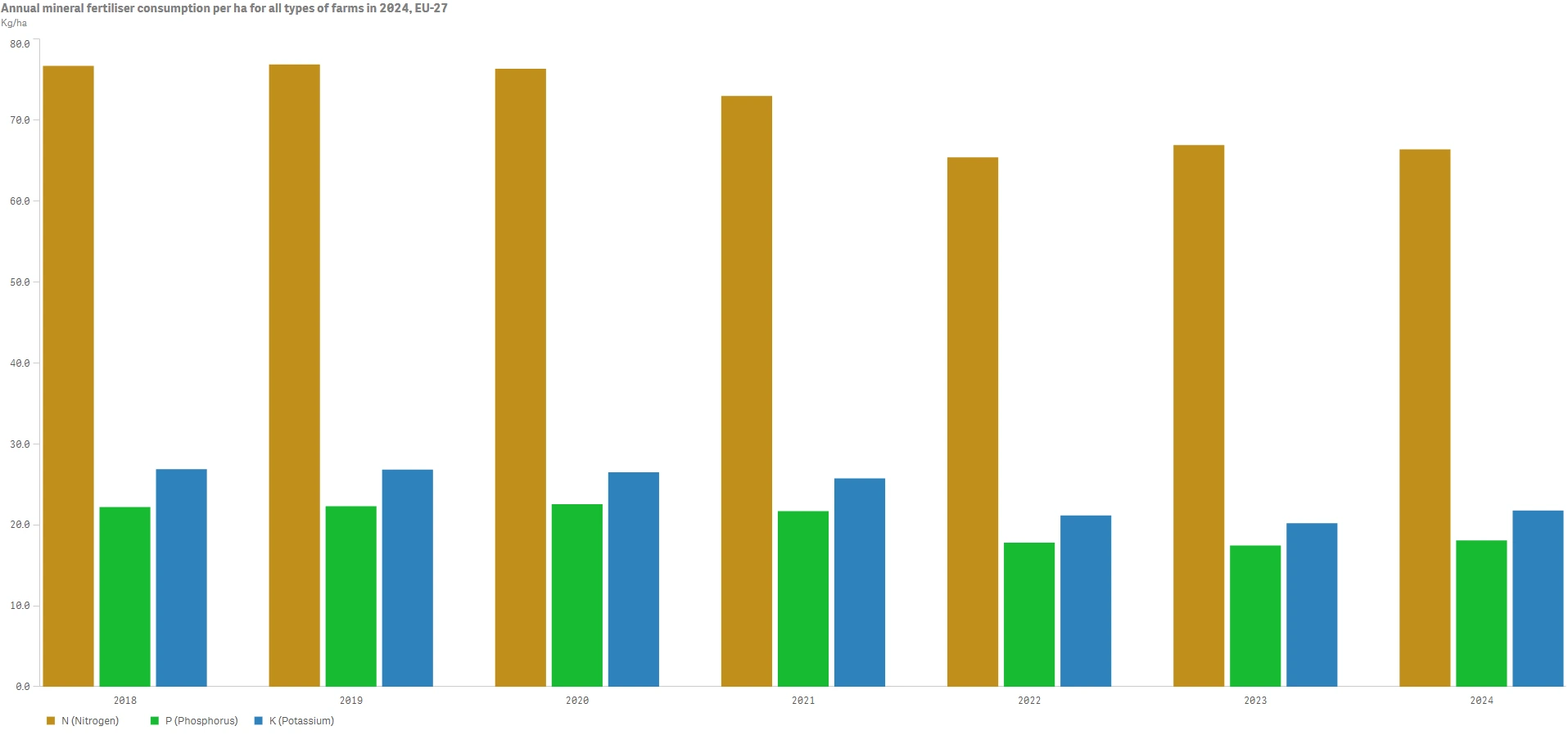
The mineral fertiliser market is in a phase of price stabilisation after historic peaks, with average nitrogen use in the European Union at approximately 66 kg per hectare. Analysis of data from the European Agridata price-monitoring system indicates that valuations of key raw materials have flattened after the dynamic increases of previous years. Phosphate and potash use on EU-27 farms is stabilising at approximately 18 kg/ha and 22 kg/ha respectively.
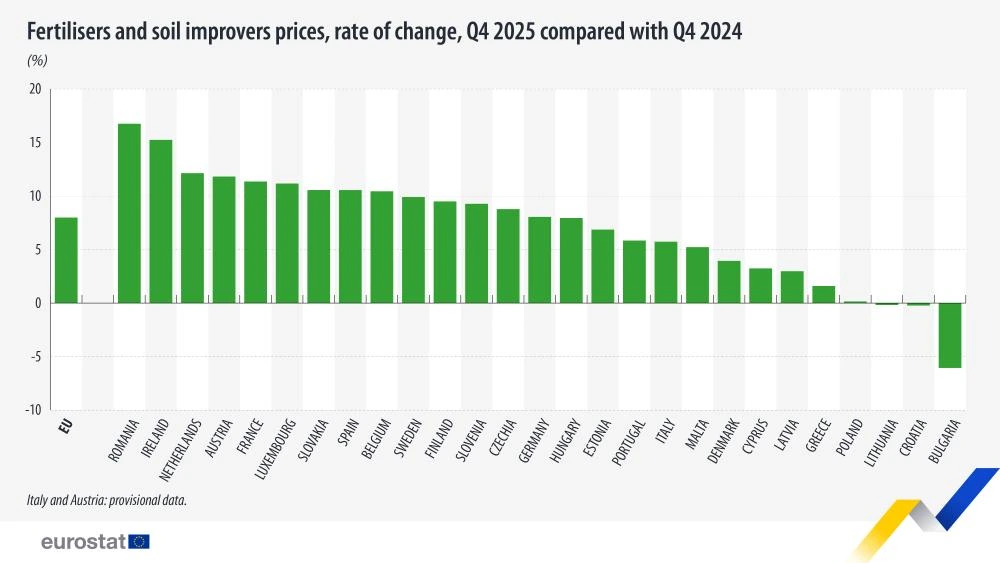
Price dynamics nevertheless differ between Member States: while soil improver prices rose moderately year on year in most EU countries, countries such as Romania and Ireland recorded increases of up to several dozen percent. The main factors shaping fertiliser prices are natural-gas quotations, maritime and rail logistics costs, and tariff and customs decisions at the Union’s borders.
Mineral fertilisers – types and characteristics of the individual raw-material groups
Mineral fertilisers are divided into single-nutrient and multi-nutrient products, among which nitrogen, phosphate and potash preparations play a key role in agricultural production. Under the Act of 10 July 2007 on fertilisers and fertilisation (Journal of Laws of 2023, item 569), mineral fertilisers are inorganic fertilisers that are not EU fertilising products and are produced through chemical transformations or the processing of mineral raw materials. The main subgroups include:
- Nitrogen fertilisers – including ammonium nitrate, ammonium sulphate and urea.
- Phosphate fertilisers – obtained by processing phosphate rock (e.g. superphosphates).
- Potash fertilisers – based on potassium salt and kainite.
- Agricultural lime – used to neutralise soil acidity, including magnesium-containing varieties.
It is important to remember the legal restrictions in force on the Polish market. Under Article 20b of the above-mentioned Act, the use of urea in granular form is prohibited unless it contains a urease inhibitor or a biodegradable coating.
Nitrogen fertiliser and urea prices – analysis of purchase costs per tonne
Nitrogen fertiliser prices depend mainly on natural-gas quotations, ranging on the European market from EUR 300 to EUR 400 per tonne depending on type and chemical purity. When analysing the price of urea per tonne, the additional technological cost resulting from the requirement to add urease inhibitors must be taken into account. Purchase volumes and distance from production plants also affect the final price. Businesses planning wholesale purchases of agricultural raw materials can review the current Amberlan commercial offer, to align their supply strategy with current market conditions.
Where to import raw materials and how to import fertilisers from abroad?
Raw materials are best imported from Eastern countries and Central Asia, which have the largest raw-material and production base. Proper fertiliser imports from abroad require structuring a logistics chain covering rail transport, border transhipment and road and sea transport. Securing continuity of supply through long-term volume agreements directly with producers is crucial for an importer. These measures minimise the risk of downtime and make it possible to obtain an attractive unit price per tonne of goods.
Fertiliser customs clearance and legal requirements under Polish and EU regulations
Customs clearance for fertilisers imported from third countries requires presenting complete technical documentation and registering in customs systems as well as tariff verification in the TARIC database. Under Polish law, fertilisers imported from outside the EU must meet the criteria set out in Articles 3 and 4 of the Act on fertilisers and fertilisation, which often entails obtaining a permit from the Minister of Agriculture and Rural Development. Special restrictions apply to ammonium nitrate: fertilisers containing more than 28% nitrogen in the form of ammonium nitrate must have a valid resistance-to-detonation certificate issued by an accredited body in the EU. The State Plant Health and Seed Inspection supervises commercial quality and compliance with standards at the borders.
Transport of liquid and bulk fertilisers and storage requirements
Transporting liquid and bulk fertilisers requires a specialist fleet adapted to carrying agricultural chemicals and compliance with strict storage standards. Chapter 4 of the Act on fertilisers and fertilisation imposes specific duties on carriers and warehouse operators:
- Loose bulk fertilisers – must be protected against spillage, dust and getting wet during transport.
- Liquid fertilisers – must be transported and stored in closed, leakproof tankers or tanks.
- Permanent storage – solid fertilisers are stored in unit packaging or piles on a hardened, impermeable surface under a watertight cover (excluding ammonium nitrate with a high nitrogen concentration).
Breaching these rules results in administrative penalties imposed by the Environmental Protection Inspectorate.
How to order fertilisers wholesale and build lasting supply relationships
When ordering fertilisers wholesale, agricultural businesses and distributors should prioritise partnerships with entities that have direct access to producers and transhipment hubs. Wholesale purchasing makes it possible to negotiate favourable payment terms, such as bank letters of credit, and secure a regular delivery schedule during peak demand. To discuss the possibility of importing raw materials or verify import procedures, it is worth contacting Amberlan advisers, who support transactions on international markets.
Summary – safe and profitable trade in the fertiliser market
Proper navigation of international markets requires combining logistics knowledge, customs law and current market realities. Safe import and distribution of mineral fertilisers enable farms and wholesalers throughout the country to build a competitive advantage.
Comprehensive operational support, investment advice and raw-material trading brokerage are offered by https://www.amberlan.com/ – your trusted partner in trade relations with the East and EU markets.
Sources and bibliography
European Commission, EU Agridata – Fertilizer Prices Report, https://agridata.ec.europa.eu/extensions/DashboardFertiliser/FertiliserPrices.html [accessed 18 August 2026].
Eurostat News, Fertilisers and soil improvers prices rate of change, https://ec.europa.eu/eurostat/web/products-eurostat-news/w/ddn-20260519-1 (2026) [accessed 18 August 2026].
European Commission database, EU Customs Tariff, https://taxation-customs.ec.europa.eu/online-services/online-services-and-databases-customs/eu-customs-tariff-taric_en (TARIC) [accessed 18 August 2026].
Notice of the Marshal of the Sejm of the Republic of Poland of 27 January 2023 on the publication of the consolidated text of the Act on fertilisers and fertilisation (Journal of Laws of 2023, item 569), https://www.dziennikustaw.gov.pl/D2023000056901.pdf [accessed 18 August 2026].